
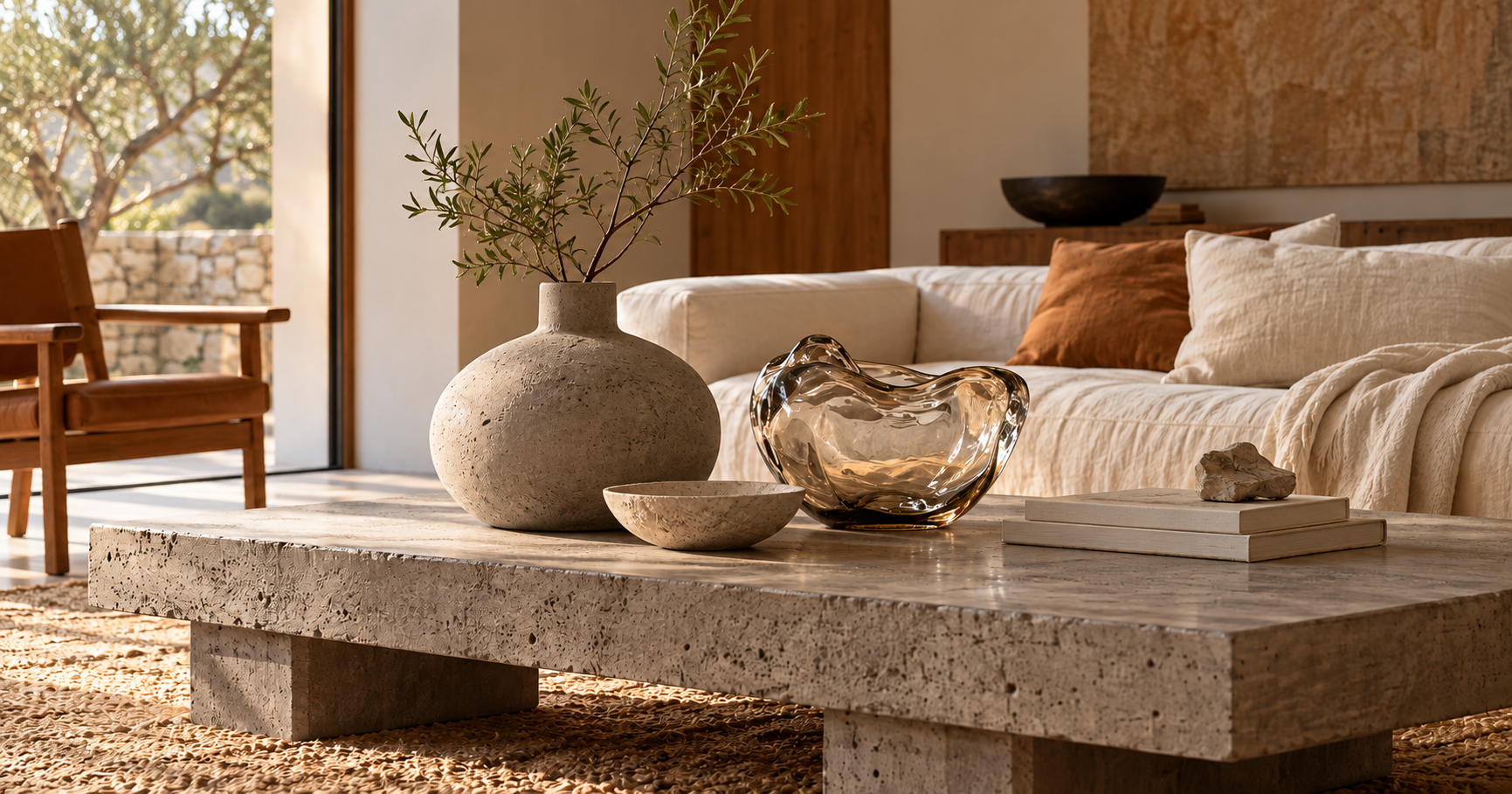
"Brutalist" is a word that makes people picture grey concrete towers and rooms with nowhere soft to sit. So it is a fair question: if your home is full of linen, wood, worn rugs and cushions that have been sat on for years, does a cement or heavy glass object belong there at all?
It does, and often it looks better there than in a stark white room. A raw material reads most clearly when something gentle sits beside it. The point is not to turn a lived-in room into a gallery. It is to give the room one quiet, solid anchor.
Why soft rooms need a hard object
Soft rooms have a lot going for them: warmth, comfort, a sense that people actually live there. What they can lack is a point of focus. When every surface is textile and every edge is rounded, the eye drifts. A single object with weight, a clear edge and an honest material gives the eye somewhere to land.
Brutalism, at its root, is about materials shown as they are rather than dressed up. That idea sits comfortably next to natural linen, unfinished wood and handmade ceramics, because they share the same instinct: let the material speak.
Principle 1: Let one object lead
The most common mistake is grouping several strong pieces together. In a soft room, one object with real presence does more than three competing for attention.
The Guggenheim Museum Model from the Monument collection is a handcrafted cement architecture sculpture, and it works best given room to breathe. Place it on a wooden sideboard or a deep windowsill with nothing else at the same height nearby. The spiral form and the grain of the cement do the work; the warm wood underneath stops it feeling cold.
Principle 2: Contrast texture, not colour
Soft rooms are usually built on a gentle palette: oatmeal, cream, warm white, muted wood. You do not need to break that palette to bring in a brutalist object. Break the texture instead.
Matte cement against a nubby linen throw, or dense glass against a woven basket, creates contrast without noise. The palette stays calm; the room gains depth.
The Cream Abstract Round Vase shows how this can work in glass. Its milky cream translucent body, marbled with orange, aqua green and lavender, sits inside a warm neutral palette while the smooth glass surface still stands apart from fabric and wood around it.
Principle 3: Choose weight that matches the furniture
A heavy object on a flimsy side table looks anxious. A small object on a large, solid console looks lost. Match the visual weight of the piece to the furniture it sits on.
The Lake Mountain Glass Vase Large is a weighty liuli glass vase with an elongated body, rounded shoulder and narrowed mouth. Its scale suits a solid surface such as a long console, a sturdy dining sideboard or the floor beside a deep armchair. On a small, delicate table, it would overwhelm. On something with matching substance, it feels settled, like a landscape object should.
Principle 4: Soften the edges with what surrounds it, not the object itself
Rather than trying to make a strong object look softer, let the setting do that. A few practical ways:
- Light: place glass where it catches daylight from the side, so its surfaces glow rather than glare.
- Textiles nearby: a runner, a folded throw or a linen cloth under or beside the object frames it gently.
- One organic element: a loose branch or a few dried stems in a vase near a cement piece is enough. You do not need a full arrangement.
- Space: leave clear surface around the piece. Soft rooms often fill every surface; one cleared area signals that the object was placed on purpose.
Principle 5: Bring in a playful counterpoint
A lived-in room is personal, and it can take a little wit. The Maison Dada Daffodil Vase pairs a clear fluted glass body with an architectural base, offered in black or wood. The wood base option in particular blends into rooms built on natural timber, while the form adds a touch of surrealism that stops a calm room becoming too serious. It suits a desk, a shelf or a small floral composition.
Three room set-ups to try
Room: Living room; Soft base: Linen sofa, wool rug, warm wood sideboard; The anchor: Guggenheim Museum Model alone on the sideboard
Room: Entryway; Soft base: Woven basket, painted wall, simple bench; The anchor: Lake Mountain Glass Vase Large on a solid console
Room: Study or reading corner; Soft base: Armchair, throw, bookshelf with mixed spines; The anchor: Cream Abstract Round Vase or Maison Dada Daffodil Vase on the shelf, near side light
What to avoid
- Matching everything to the object. Do not swap your cushions for grey ones to "go with" cement. The contrast is the point.
- Crowding. A strong object surrounded by small trinkets loses its presence.
- Hiding it in shadow. Raw cement and dense glass both need light to show their surface. A dark corner flattens them.
A calm room, with one solid voice
A brutalist object does not ask a soft room to change. It asks for one cleared surface, honest light and a bit of space. Give it those, and it becomes the piece that holds the room together.
Explore the Monument and Glass Forms collections at bruta.luxe to find the object that fits your room.