
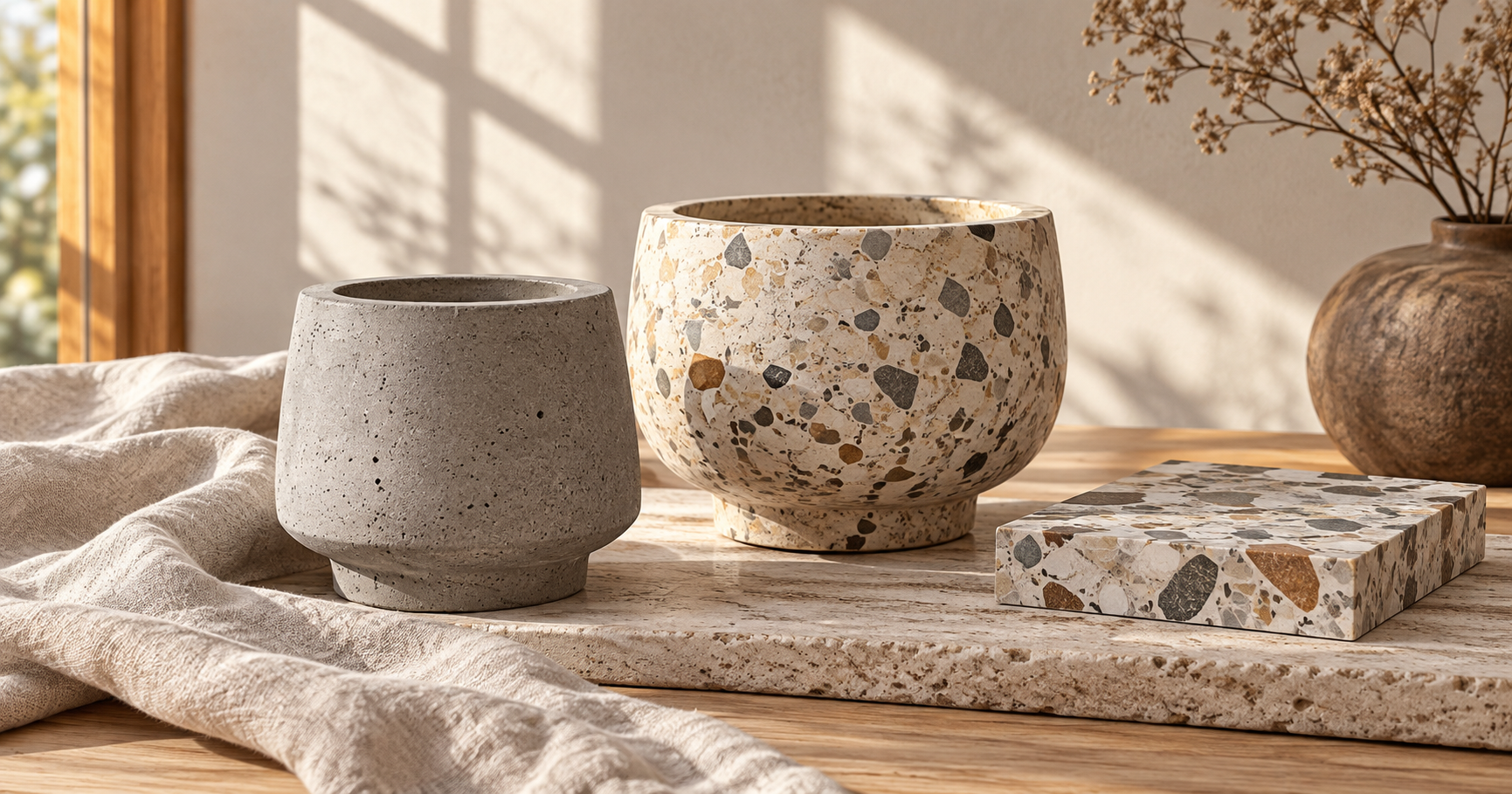
Most shops use "cement" and "concrete" like they mean the same thing. They don't — and the difference changes how your vase ages, stains and holds up.
The short answer
Cement is the binder — a fine grey powder that, mixed with water, hardens through a chemical reaction called hydration. On its own, cement is rarely used for anything structural; it's the glue, not the building material.
Concrete is cement mixed with water and aggregate — sand, small stones, or crushed gravel. The aggregate is what actually gives concrete its bulk, strength, and the slightly speckled texture you associate with a poured floor or a garden step. Almost everything people casually call "cement" — a cement vase, a cement countertop, a cement planter — is technically concrete, because pure cement paste without aggregate is rare, expensive, and prone to cracking as it dries.
Terrazzo is concrete (or occasionally a resin-based binder) with larger decorative aggregate mixed in deliberately for visual effect — marble chips, glass fragments, coloured stone — then ground and polished flat so the aggregate shows as a pattern across the surface. It's a decorative technique layered on top of the same basic cement-and-aggregate chemistry.
So the family tree runs: cement is the ingredient, concrete is the mix, terrazzo is a decorative variant of that mix. When a product description says "cement," in almost every case it means a fine-aggregate concrete, and that's usually not worth arguing about — but it's worth understanding when you're comparing how different pieces will actually behave.
How each behaves in a home object
Weight. Fine-aggregate concrete mixes used for decor objects are noticeably heavy for their size — part of what makes a small vase feel substantial rather than hollow. Terrazzo, because it often incorporates lighter decorative chips, can be marginally lighter for the same volume, though the difference is small in an object this size.
Surface. A fine concrete mix produces a smooth, slightly matte surface with subtle natural variation — small air pockets, faint colour shifts, a texture closer to stone than to plastic. Terrazzo's surface is intentionally patterned and requires grinding and polishing after casting to reveal the aggregate, which typically gives it a glossier, more uniform finish than an unpolished concrete piece.
Porosity. All three are porous to some degree — this is a property of the cement hydration process itself, not a manufacturing flaw. Polished terrazzo is generally less porous at the surface than unpolished concrete, because grinding closes some of the surface pores, but the underlying material is equally susceptible to staining from acids and prolonged moisture contact.
Colour stability. Plain concrete tends to develop a gentle patina over years — very minor colour shifts from light exposure and handling, generally read as ageing rather than damage. Terrazzo, because its visual identity depends on the contrast between the aggregate chips and the surrounding binder, shows this kind of ageing less visibly, since the pattern itself doesn't shift even if the binder around it does.
Which is used for what in decor, and why
Fine unpolished concrete is the standard choice for objects meant to read as sculptural and material-first — vases, planters, small architectural forms — because the subtle surface variation is part of the appeal rather than something to be ground away. It's also faster and less labour-intensive to finish, since there's no polishing stage.
Terrazzo is generally chosen when the goal is a more decorative, patterned surface — tabletops, coasters, larger flat pieces where the aggregate pattern has room to read clearly. On a small vessel, the polishing and pattern can compete with the form of the object itself rather than complementing it, which is part of why terrazzo tends to show up more in flat or large-surface pieces than in small sculptural ones.
What Brutaluxe casts with and why
Brutaluxe pieces use a fine-aggregate concrete mix, cast and cured unpolished — the surface you see is the surface the mould produced, with no grinding stage to flatten out the material's natural variation. That's a deliberate choice tied to the brand's broader material philosophy: the small, honest imperfections in a concrete surface — the kind that a polished terrazzo finish would smooth away — are treated as evidence of the casting process rather than something to disguise.
It also matters for weight and proportion at the scale Brutaluxe works at. A fine unpolished mix holds crisp detail in small forms — the corner of an architectural model, the curve of a vessel — better than a mix with larger decorative aggregate, which can blur fine detail at small scale the way a coarse-grain photograph blurs fine text.
What this means when you're buying
A few questions worth asking any seller of cast concrete or cement objects, regardless of brand:
- Is the surface polished or left as-cast? This tells you whether you're looking at a decorative terrazzo-style finish or a material-first piece.
- What's the aggregate? Fine sand-based aggregate gives a smooth, subtle surface; larger decorative aggregate (marble chips, glass) means you're looking at a terrazzo-style piece even if it's marketed as "cement."
- How is it sealed, if at all? Affects long-term staining resistance and whether the piece needs any special care beyond a damp cloth.
- Is variation between pieces expected, or is every unit meant to look identical? A genuinely handmade, unpolished piece will show natural variation from unit to unit — a red flag if a seller claims otherwise while describing something cast by hand.