
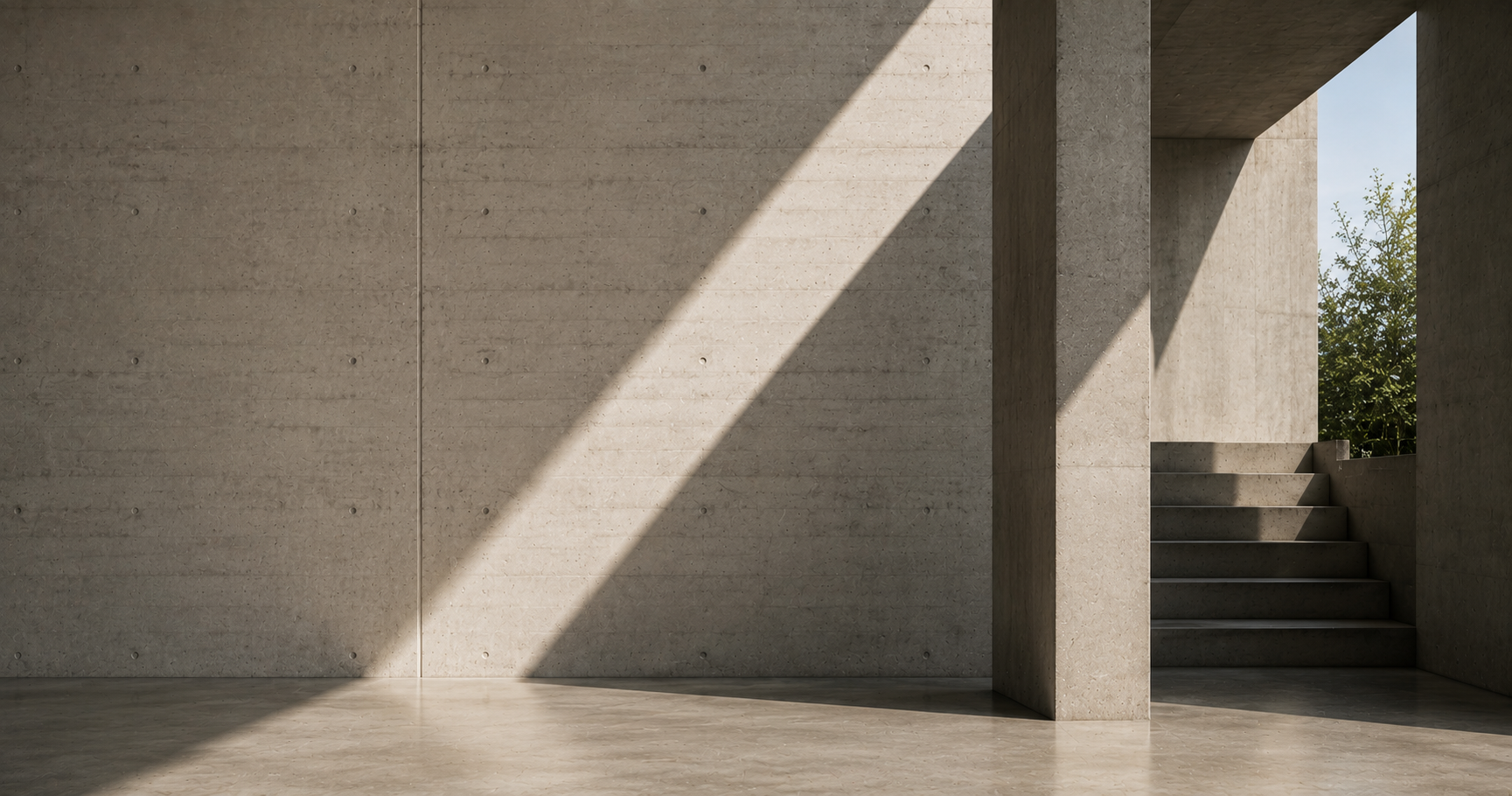
Brutalism has nothing to do with brutality. The word comes from béton brut — French for raw concrete — and the movement it names was arguing for honesty, not harshness. The resemblance to "brutal" is a coincidence of language that the style has never quite lived down.
Where the phrase actually comes from
Béton brut was the term Swiss-French architect Le Corbusier used for concrete left in its raw, unfinished state straight from the formwork — including the visible grain of the wooden moulds it was poured into. He used it extensively in his post-war buildings, most famously the Unité d'Habitation in Marseille, completed in 1952. The concrete wasn't smoothed, painted, or clad. What you saw was what had actually been built.British architects picked up the term in the 1950s, anglicised it to "brutalism," and it stuck — first as a descriptor, then as the name of a movement that spread across Europe, the Americas, and beyond through the 1960s and 70s.
What the movement was actually arguing for
Strip away the decades of association and the original argument was straightforward: a building's structure and materials shouldn't be hidden behind a decorative skin. If concrete is what's holding the building up, let concrete be what you see. If a pipe or a structural beam is doing real work, don't box it in to make it look like something else.This was as much an ethical position as an aesthetic one. Post-war Europe needed housing, schools, and civic buildings built quickly and affordably, and architects like Le Corbusier, Alison and Peter Smithson, and later Denys Lasdun and Ernő Goldfinger saw raw concrete as democratic — cheap enough to build at scale, honest enough not to pretend otherwise. Ornament, in this view, wasn't just expensive. It was a kind of lie about what the building actually was.
Why it became a slur
The reputation problem arrived in two stages. First, cheap and poorly maintained imitations — buildings that copied the raw-concrete look without the material rigour or civic ambition behind it — gave the aesthetic a bad name by association. Concrete that isn't detailed and maintained properly stains and streaks badly in wet climates, and a lot of brutalist housing built quickly on tight budgets aged visibly worse than the landmark buildings the style is now remembered for.Second, the name itself did the rest of the work. Once "brutalist" existed as a word, it was almost impossible for the general public to hear it and not think of brutality, regardless of the French etymology. By the 1980s, "brutalist" had become shorthand in general use for cold, oppressive, totalitarian architecture — a reading that had more to do with the sound of the word than the ideas behind it.
The reappraisal
Over the past fifteen years or so, brutalist architecture has been steadily rehabilitated — heritage listings for buildings once slated for demolition, coffee-table books, an active online community of enthusiasts photographing and cataloguing brutalist structures worldwide. Part of this is straightforward nostalgia; part of it is a design culture that's grown tired of surfaces that hide what they're made of, and found something honest in structures that never tried to.That's the same shift that makes raw material-forward decor interesting again now, after a long period where most home objects were designed to disguise their construction under paint, veneer, or glaze.
What translates from building scale to object scale
A building and a vase solve different problems, and not everything about brutalist architecture translates down to a shelf-sized object. The movement was partly about mass and civic scale — the sheer physical weight of raw concrete used to make a democratic argument about public space. A small cast object can't make that argument, and shouldn't try to.What does translate is the underlying principle: material honesty. A cast cement object that shows its surface as it actually is — the fine texture, the slight variation, the weight — is applying the same logic at a completely different scale. Nothing is hidden under a glaze or a finish designed to make it look like a different, more expensive material. The object is what it's made of.
Where the Brutaluxe name sits in that
The name is a deliberate pairing of two words that don't usually appear together — raw material and refined intent. It's not a claim to the civic ambitions of the original movement, and it's not scaling a building-scale idea down to tabletop size for the sake of a reference. It's a smaller, more specific claim: that a material left honest, rather than disguised, can still be considered, well-made, and worth living with.Béton brut, at the scale of a shelf.